Labels

THIS BLOG IS ALL ABOUT TECHNOLOGY. PLEASE DO VISIT THIS BLOG DAILY FOR LATEST TECHNOLOGY. AND KINDLY DO FOLLOW THIS BLOG.

Friday, January 7, 2011

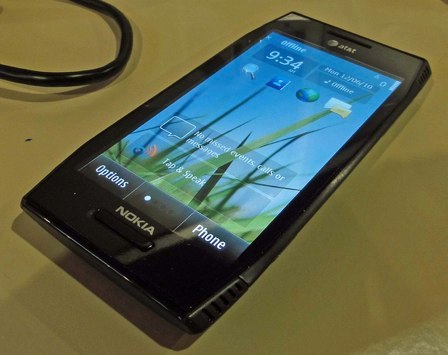
Nokia Plans New Symbian Smartphone for AT&T in Q1, Might Be Nokia X7

Nokia X7Finnish mobile phone maker Nokia has confirmed a few days ago plans to launch a new handset on AT&T's airwaves in the United States during the first quarter of the ongoing year. 

While no specific info on the new device was unveiled for the time being, nor a name for it provided, Nokia did say that it would be a Qt enabled Symbian smartphone. 

The new device might be the previously rumored Nokia X7, which was already spotted at large with AT&T's logo on the front. 
However, this does not exclude the possibility that another device would be on its way to the wireless carrier's network, one should agree.

When it comes to the specification list of this mobile phone, we should note the said Symbian OS (the new Symbian^3 platform), along with an 8-megapixel photo snapper with dual LED flash, clearly visible on its back.

The handset was also said to come with advanced gaming capabilities, one of which would be four speakers, places on each of its corners, it seems.

No other details on this mobile phone emerged, but more on its specifications and features should be unveiled in the near future, provided that it is indeed set for a Q1 release at the US wireless carrier.

According to thenokiablog, the mobile phone should sport an affordable price tag when released on the shelves of AT&T, though it would require a contract agreement.

The announcement on the upcoming availability of a new Symbian mobile phone at AT&T was made during the AT&T Developer Summit at the Nokia Technical session in Las Vegas.

Also there, Nokia said that it would extend the deadline for its $10M Calling All Innovators competition for the last day of this quarter, March 31, 2011.

Apparently, Nokia is enjoying increasing interest from the North American developers during the Qt trainings it held on the continent, and decided to offer devs more time to deliver their creations.

It remains to be seen whether the rumor on the arrival of Nokia X7 at AT&T would pan out or not, so keep an eye on this space for more info on the matter.

Intel Shows Tiny PCs With Surprising Graphics Power

We just visited the Intel booth at CES and saw some laptops and tablets that are packing a serious punch.
Stroll around the booth with us as we take a close look at the array of laptops and tablets Intel is showing off, as the company touts the benefits of its latest processors inside. Some are running WindowsWindows, and others run AndroidAndroid. Don’t be fooled by the diminutive size of these devices; many are small enough to fit into a coat pocket.
Stay tuned, because we have video on the way. Meanwhile, here’s a gallery with the coolest examples Intel had on display, complete with descriptions of each:

HANDS ON: SmartCradle Boosts GPS, Charges iPhone

Pioneer’s SmartCradle is made specifically for the iPhone, and it might be one of the more useful accessories we’ve seen at CES.
Pioneer says it can boost GPS signals, and its amplification works not only on navigation apps; it’s said to enhance the performance of any location-based app that uses the GPS function.
In addition, it has an audio/video output jack; and its built-in amplified speaker and microphone make it easy to place a hands-free call.
We took a close gander at this $129 cradle at CES, and it feels like a solid piece of gear. Getting its power from a car’s cigarette lighter, it rotates easily from portrait to landscape mode and locks down tight enough onto an iPhone to keep it from tumbling into your lap.
We also like the way it’ll charge the iPhone while it’s in use, an important consideration considering the intense power-hungriness of every GPS app we’ve used. Look for it in April.

Startup Turns Artificial Intelligence into Serendipity Engine for Mobile


This post is made possible by Microsoft BizSpark as a new part of the Spark of Genius series that focuses on a new and innovative startup each day. Every Thursday, the program focuses on startups within the BizSpark program and what they’re doing to grow.
If the name Clever Sense doesn’t ring a bell, that’s likely because the nearly three year-old Mountain View-based startup has been operating under the radar for much of its existence, bootstrapped by co-founder Babak Pahlavan.
The company is applying artificial intelligence to location-based services and is readying a big release of its first product, Seymour, for iPhone and Android. It is expected toward the end of the first quarter. Clever Sense has also raised roughly $1.5 million in financing, is aggressively going after more funds, has four Ph.Ds on staff and has scored a renowned advisor in Stanford Professor Jeff Ullman, who was the Ph.D advisor to Google co-founder Sergey Brin. As such, Clever Sense is a name that you will know soon enough.
So, what is it and what does it do? “Clever Sense is an artificial intelligence-based, context-aware platform for location-based services. It’s the culmination of artificial intelligence, machine learning and data learning,” explains Pahlavan. “It’s a next generation Siri.”
In layman’s terms, Clever Sense has crafted technology to personalize your mobile experience. The technology will be used in company-built and third-party mobile applications that aim to harness data from your social graph and location in conjunction with place and time information to create serendipitous experiences in mobile.

Seymour, Your Personal Concierge


Seymour provides a first, appetite-whetting taste of how Clever Sense’s technology can be applied to real world, practical problems. Seymour recommends places based on where you are, who you’re with and what you want in the moment.
It resembles Siri, but goes further to discover what is good or bad about a place through sentiment analysis of Yelp and Citysearch reviews, and saves personal “Taste Cards” for you, based on your mood and preferences.
Ask Seymour for places that serve lunch or dinner and use descriptive words and phrase like “vegan,” “cheap” or “group-friendly” to narrow your query and the app will work to match your interests to nearby places. You can even further specify that you’re looking for something similar to place you know you like, say, Peet’s Coffee or The Cheesecake Factory.
Seymour is designed to process natural language commands, as opposed to queries, so you can ask it something nearly identical to what you’d ask a friend. It’s meant to be conversational and friendly. Pahlavan describes the overall experience as “searchless, search.”
Once Seymour recommends top places, you can teach it to better recognize your tastes by giving suggested places thumbs up or thumbs down reviews. Suggestions are revised as you rate places. Eventually, Seymour will learn from your Facebook Places and Foursquare checkins too.
The beta mobile application was recently released for Windows Phone 7. Pahlavan stresses that the application was released merely to solicit feedback, but he’s been impressed with the response so far. The startup also has its eye on hotter mobile platforms: iOS and Android. More sophisticated versions of Seymour are currently in the works for each platform.

The Road Ahead


A company like Clever Sense, which relies on the sophistication of its technology to stand out, is only as good as the people it employs. The current team is comprised of top engineers, AI and machine learning experts and Ph.D holders. But, once Clever Sense makes its big mobile push onto iPhone and Android, the startup will need to expand its team to support growth.
Finding quality talent will be Clever Sense’s greatest challenge, according to Pahlavan. There’s an ongoing talent war between Google, Facebook and Apple that makes it difficult for a lesser known startup like Clever Sense to find the best candidates and offer them a competitive-enough compensation package, he says. The startup will need to raise more funds should it wish to compete.
But Pahlavan has confidence in Clever Sense’s ability to carve out a new frontier in mobile. “There’s no else in mobile doing what we’re doing,” he says.
And he may be right. You may recall that Siri was acquired by Apple. Should Clever Sense’s technology be as good as Pahlavan describes, it too will have a bright future. But first it will have to find an audience.
“This is just the beginning of a long story,” Pahlavan says. We hope he’s right.

Nike Unveils GPS Sportswatch for the Data-Happy Runner

Nike has announced the latest addition to its existing line of Nike+-integrated products, the Nike+ SportWatch GPS.
The watch enables runners to track their time, pace, distance, route, heart rate and calories burned with a simple three-button interface and tap screen. Users can also view their run history with data from past runs and personal records imported from Nike+, and they can set up their watch to keep lap-by-lap pace and for interval training.
It’s a great watch for those who want to take advantage of all of the features Nike+ has to offer, and access vital data while on the run, without having to carry an iPod or iPhone to do so.
“It’s a great wrist-based solution for those who want to map their runs and don’t want to run with a phone,” says Michael Hailey, the user experience lead of Nike’s digital sport division.
And because it includes a sensor that links to the Nike+ ecosystem, runners can still track their runs even when they don’t have access to GPS or are running on a treadmill.
There are also a few fun bonus features. The watch will applaud runners for breaking personal records and finishing their runs, for instance, and even give them a little nudge to hit the pavement if they haven’t logged a run in five days.
Afterwards, the watch can be plugged into a USB port on a Mac or PC to transfer their run data tonikeplus.com. Nike plans to take advantage of the influx of GPS data to help surface “cool places to run, the top routes in your area and routes your friends are running,” among other things, Hailey tells us.

Wednesday, January 5, 2011

To Make Electric Cars a Success, it’s Still About the Battery


Building a functioning electric car is far from rocket science. In fact, electrics actually pre-date gasoline internal combustion power. Building an electric car that meets and exceeds consumer needs in terms of range, performance, drivability, and safety at an acceptable price point is the hard part.
And when it comes to price and performance, it’s all about the battery. An advanced technology battery can easily account for half the cost of an electric car running solely on battery power. While somewhat less challenging for a plug-in hybrid or range-extended electric car since these use smaller battery packs, it's still very much an issue with engineers and product planners alike. Battery technology is advancing at a rapid pace, but for the modern electric car, rapid doesn’t seem fast enough.
One of the most graphic examples of just how far battery technology has come in the past 12 years is presented by comparing the battery pack fitted to GM’s EV1 to the current Volt battery pack. Both batteries take on the now familiar ‘T’ shape, but the EV1’s first-generation lead-acid pack was nearly twice the size, and at 1,200 pounds three times the weight, of the considerably more powerful 375 pound lithium-ion pack that will power the Volt.
We recently had the opportunity to tour GM’s advanced battery lab just outside Detroit for the second time. Our latest peek inside was of GM’s new and improved $25 million Global Battery Systems Lab in the automaker’s Warren, Michigan Technical Center. At 33,000 square feet, the facility is a state-of-the-art testament to GM’s commitment not only to the Volt and Voltec programs, but to future advanced electric powertrain systems that will include hybrid and fuel cell vehicles. In the midst of a troubled year for the world’s second largest automaker, the emphasis this facility places on cleaner, greener vehicles is clearly a bright spot worth shouting about.
The new facility employs over 1,000 engineers and technical employees primarily focused on the Volt program. GM also has battery labs in Mainz-Kastel, Germany and Honeoye, New York, with the ability to videoconference and share information on a real-time basis. The new Warren lab has a maximum power capacity of 6 megawatts, or more than 1,500 American homes. It has 32 battery cyclers running around the clock to measure battery longevity and performance, and 42 thermal chambers that put the cells through extreme temperature and humidity tests. The lab also employs a thermal shaker table to test durability and structural integrity of the battery packs.
Last January, GM announced it will build its Volt battery packs in a new assembly plant to be located in Michigan. Production tooling is scheduled to be installed by mid-2010 with production to follow later in the year. Lithium-ion cells will be supplied by LG Chem with assembly in the ‘T’ battery packs handled at GM’s Michigan battery plant.
To understand the complexity of the battery game, consider how far GM has come with the project since it was announced just a few short years ago. More than 155 unique battery chemistries from 115 different suppliers were analyzed at the outset of the program. From those, 60 chemistries from roughly 20 suppliers were tested in GM labs around the world. To date, GM has evaluated more than 14,200 cells.
Nobody said that bringing the revolutionary Volt to market would be easy. From what we’ve seen, the gloomy news from Detroit and Washington has only made the GM Volt team more committed than ever to make this car a reality that not only meets, but exceeds, expectations.

All-New 2011 Hyundai Elantra Delivers Style and 40 MPG


The all-new 2011 Hyundai Elantra sets a new fuel economy benchmark in the compact car segment. Every new Elantra that drives off a Hyundai dealer’s lot will deliver a highway fuel economy rating of 40 miles per gallon. That’s true for both manual and automatic transmission models. There are other compact cars that offer 40 mpg on the highway, but as Hyundai is quick to point out, you must order a special model to obtain that high mileage.
Fortunately, great gas mileage is just one of the many things to like about the new fifth generation Elantra. Think of it as ‘Sonata Lite.’ The new Elantra is light years ahead of this automaker’s earlier generation cars in every respect. From the first time you climb behind the wheel, Elantra hardly feels like a compact car. It simply has a larger on-road presence. For 2011, Elantra grows an inch in overall length and two inches in wheelbase. That stretched wheelbase combines with great suspension tuning to add up to a very pleasing car to drive.
The Elantra’s powertrain is all-new as well. Replacing the Beta 2.0-liter four-cylinder is a Nu 1.8-liter Dual CVVT engine. Though Hyundai didn’t fit the engine with direct injection like the Theta II engine in the Sonata, it was engineered to accept the technology in the future. Still, the new engine delivers 7 percent more horsepower and is 74 pounds lighter than its predecessor. Hyundai rates power output at 148 horsepower at 6,500 rpm and 131 lb-ft of torque at 4,700 rpm.
During our test drive on canyon roads, mountain passes, and stretches of interstate in Southern California, the new Elantra consistently delivered peppy performance. Both the six-speed manual and six-speed automatic are fun to drive. The automatic offers Shiftronic manual shift mode for those times when a bit more control over gearing is desired. What does 40 mpg get you? In the case of the Elantra you can cruise more than 500 miles on the highway between fill-ups. Best of all, a manual shift Elantra GLS starts at just $14,830 … quite the deal.